Silk, Cotton or Wool for a Lightweight Scarf?
Silk, cotton or wool for a lightweight scarf: compare feel, drape and visual character to choose a fabric that suits your outfit and preferred finish.
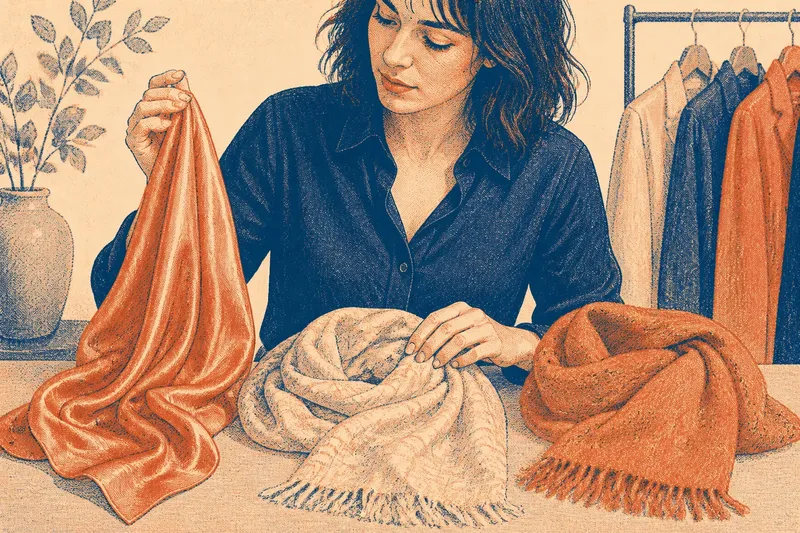
A silk, cotton or wool lightweight scarf can change an outfit before its color does: the fiber shapes how the fabric settles, catches light and holds a fold. If you are choosing among the three, start with the effect you want around the face—fluid and polished, crisp and easygoing, or soft and quietly textured.
Fiber is only part of the picture. Weave, yarn thickness and finishing can make two silk scarves behave differently, just as a fine cotton voile has little in common with a dense cotton bandanna. Still, each fiber has a recognizable tendency. Knowing those tendencies makes it easier to read a scarf on a hanger or in a product photograph without treating the label as a complete description.
Silk gives a scarf fluid movement and a clear sheen
Silk fibers are smooth, so a lightweight silk scarf often feels cool and sleek against the skin. A fine weave can make the fabric nearly weightless, while a twill weave gives it a little more body without losing its characteristic soft fall. The exact finish matters: some silk is glossy, some is subdued, and matte silk can look more restrained than the familiar polished square.
In use, silk tends to make narrow folds and hang close to the neck. It can be tied into a small knot or looped once without adding much visible bulk. That quality suits a scarf worn under an open collar, tucked into a jacket, or laid over a simple knit when a smooth line is preferable to a gathered one.
Its visual effect can be dressy even when the print is casual. Light skims the surface, giving solid colors depth and making printed edges appear crisp. If you want a scarf to echo the clean finish of a silk blouse or tailored shirt, silk is the most direct choice. If the outfit already has shine, a matte silk weave can add movement without turning the whole look glossy.
Cotton makes the edge and weave more visible
Lightweight cotton usually feels dry and familiar rather than slick. Depending on its weave, it may have a little crispness at first or a soft, worn-in hand. A gauzy cotton scarf collapses readily, while a finely woven lawn or voile keeps a clearer edge. Cotton often shows the structure of its weave more plainly than silk, which gives even a simple solid color a tactile look.
That surface makes cotton a natural companion to denim, canvas, linen and casual knits. It can look deliberate without seeming polished, especially when the hem, fringe or woven texture remains visible. A cotton scarf also tends to form less slippery knots than silk, so a loose wrap or short tie can stay visually relaxed rather than sliding into a narrow strip.
Consider the scale of the outfit. A crisp cotton square can add a small, graphic accent to a plain shirt; a soft, open-weave scarf reads more airy and informal. Cotton’s less reflective surface keeps prints from looking overly sharp, which can be useful when the pattern is busy or the rest of the outfit already contains strong lines.
Fine wool adds a soft halo and a little presence
Lightweight wool is not necessarily heavy or bulky. Fine yarns can produce a scarf that feels soft and warm while remaining thin enough to fold close to the neck. Compared with silk, wool usually looks less reflective; compared with cotton, it often has a faint fuzz or halo that softens the outline of a color or pattern.
That softened surface gives wool a quiet, slightly relaxed character. It works well with knits, brushed fabrics and autumn-weight jackets, but a fine wool scarf can also sit neatly over a shirt when the weave is open and the styling is simple. The folds tend to look rounded rather than sharply pressed, lending a little visual volume without requiring a thick knot.
Wool can be a useful choice when a scarf should read as part of the outfit’s texture rather than as a polished accessory. A smooth coat paired with fine wool gains a softer note; a wool scarf beside a fuzzy sweater may blend in so thoroughly that it disappears. Contrast the surface if you want the scarf to remain legible.
How do you choose between silk, cotton and wool?
Which fiber has the most fluid drape?
Silk commonly has the most liquid-looking fall, especially in a fine, smooth weave. Cotton can drape softly too, but its edges and folds often look more defined, while lightweight wool tends to form rounder, softer folds.
Which scarf looks most casual?
Cotton usually reads as the most informal because its surface is comparatively matte and its weave can remain visible. A gauzy wool scarf can also feel relaxed, while a shiny silk scarf often appears more dressed even with an easy print.
Which fiber works best with a printed scarf?
There is no single best fiber; consider how clearly you want the print to register. Silk often gives colors a crisp, luminous look, cotton makes a print feel more graphic and tactile, and wool softens its edges with texture.
Can a lightweight wool scarf work indoors?
Yes, if the scarf is fine enough to sit comfortably and the outfit benefits from its soft surface. A loosely woven or thin wool scarf can add texture without the bulk of a winter wrap.
Read the fabric before deciding by fiber name
Fiber names describe the raw material, not the whole scarf. A tightly woven cotton can feel crisp, while a gauzy cotton can feel almost airy; silk may be glossy or matte; and wool may be smooth, fuzzy or open in texture. Look at the edge, the way the fabric gathers, and whether light reflects from the surface. Product images can help, but a close view of the weave often tells you more than a styled photograph.
Check the fiber content and care label before buying, particularly if the scarf will be worn often or needs a particular cleaning method. Where care or handling depends on the label, manufacturer instructions or local rules, follow those directions rather than assuming all scarves of one fiber behave alike.
Imagine you have a plain navy shirt and want a scarf that softens its clean lines without looking formal. A fine wool scarf in a muted rust shade would add a gentle halo and rounded folds; a crisp cotton one would make the accent more graphic, while silk would introduce a smoother, brighter finish. The starting outfit is the same, but the surface changes the impression.
Choose the visual job, then choose the fiber
For a silk, cotton or wool lightweight scarf, decide first whether you want polish, definition or softness. Silk brings fluidity and reflected light; cotton makes weave and edges more apparent; fine wool adds a soft outline and a little presence. Those differences are tendencies, not rules, so the actual weave and finish deserve a glance before you commit.
When an outfit feels almost right, the scarf does not need to match its most obvious feature. Use silk to smooth a textured look, cotton to give a quiet outfit a clear accent, or wool to soften a sharp one. The best choice is often the fiber whose surface supplies the quality the rest of the clothing lacks.