The Trouser Pleat and Its Changing Place in Dress
The trouser pleat shifts between practical ease and deliberate emphasis; learn how its direction, depth, and placement change the shape and reading of dress.
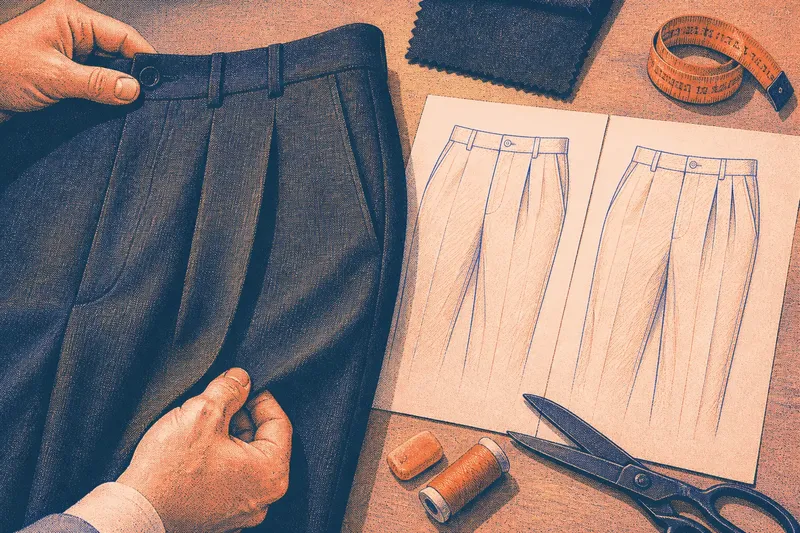
Imagine a pair of charcoal trousers arriving at a fictional alterations shop with one clear problem: the wearer can stand comfortably, but the fabric pulls across the upper thigh when they sit. The tailor notices that the trousers have a flat front, a close cut, and a waistband already adjusted to fit. The question is not simply whether pleats look good. It is what a pleat would do to the garment, and what it would say once added.
This invented case gives us a useful way to trace the trouser pleat through dress. A pleat is a fold of fabric secured at the waistband and released below it. Depending on its direction, depth, and position, it can provide room, organize fullness, or become a visible design choice. Its role has never been fixed. The same construction can answer a movement problem in one pair and supply a measured formality in another.
The trouser pleat begins as a solution to movement
In the shop, the tailor asks when the pull occurs. The wearer says it is most noticeable when sitting or climbing stairs. That detail matters: a waistband can fit well while the seat and upper thigh still need more room to move. A pleat can release fabric from the waist area into the front of the trouser, allowing the cloth to open as the body bends.
That practical function helps explain the pleat’s long presence in tailored trousers. Men’s trousers in particular have often used pleats to give a fuller upper leg while keeping the waist defined. But the construction is not exclusive to menswear, and its use cannot be reduced to a single era or dress code. Tailoring traditions, cuts, fabrics, and habits of wear all affect what a pleat does.
Ease is also not the same as looseness. A well-placed fold can let a trouser front look composed while adding room where movement calls for it. A pleat that is too deep or poorly balanced may instead billow, gape, or make the front appear crowded. The fold is a tool, not a promise of comfort.
For this pair, the first useful question is where the strain originates: at the front thigh, across the seat, or at the waistband.
Direction and position alter the front of the trouser
The tailor explains two familiar arrangements. Forward pleats fold toward the fly; reverse pleats open toward the pockets. Neither is inherently more correct. Forward folds tend to create a quieter line through the front, while reverse folds can make the pleat itself more apparent and give the pocket area a fuller impression. The result depends on the cut and how the fabric hangs.
One pleat on each side of the fly creates a restrained release of cloth. Two on each side distribute more fullness and can give the upper leg a roomier shape. These descriptions are tendencies, not rules. A single deep pleat can be more conspicuous than a pair of shallow ones; a wide leg can absorb fullness differently from a narrow one.
Position matters just as much. Pleats begin at the waistband, but the point at which they open and the way they fall influence the whole front. If they remain closed while standing, they can look like fine pressed lines. If they spread, the wearer sees more of their function. The pocket opening, fly, crease, and rise all contribute to whether the folds look integrated or like an afterthought.
Imagine the tailor comparing two paper patterns against the charcoal trousers. In the invented situation, one pattern adds a modest forward pleat and preserves the existing pocket placement; the other uses a deeper reverse pleat. The expected visible difference is a quieter front in the first version and more obvious fullness near the pockets in the second. Neither alteration is made before the wearer chooses which appearance suits the intended use.
Fabric decides how much the pleat announces itself
A pleat’s character depends on the cloth carrying it. A crisp, lightweight wool can hold a clean fold and show its line clearly. A softer or heavier fabric may let the fold relax, producing a more subdued shape or a larger fall of cloth. Cotton twill, linen, and blends each respond according to their weave, weight, finish, and pressing; the fiber name alone does not settle the question.
Pattern and surface matter too. A plain, smooth cloth makes the fold easy to read. A textured weave, a strong check, or a stripe can interrupt the line or make its direction more noticeable. A stripe that meets a pleat may shift visibly as the fabric opens. That is not necessarily a fault, but it is part of the design the wearer will see.
Construction affects the result after wear. Pleats are commonly pressed, and their crease may be maintained as part of the trouser’s finish. If the fabric softens or the fold is pressed inconsistently, the front can look less deliberate. For an alteration, the tailor needs to consider whether the existing cloth has enough allowance and whether reshaping it will preserve the garment’s balance. Care and alteration choices should follow the garment maker’s instructions and the tailor’s judgment for that fabric.
Before asking for a pleat, look at the cloth in motion, not only on a hanger.
A practical need can become a visual signal
As trouser silhouettes changed, pleats moved in and out of prominence. At times they were associated with the fuller, more formal tailored trouser; at others, flatter fronts and closer cuts became the preferred look. Those shifts are not a simple march from practical clothing to decorative clothing. A pleat can serve both purposes at once, and fashion often changes which purpose people notice first.
In a formal outfit, a pressed pleat can reinforce the sense of order created by a crease, a clean waistband, and a jacket. In a relaxed outfit, a deeper fold and wider leg can look intentional rather than ceremonial. A pleat paired with a narrow ankle and a close-fitting upper block may feel unsettled, while the same fold on a roomier cut can read as part of a coherent silhouette.
Context supplies much of the meaning. Trousers worn with a tailored jacket may make pleats look like a continuation of traditional dress. With a knit top, casual shoes, or a more generous cut, they can look like a chosen piece of volume. The fold itself has not changed; the surrounding clothes have changed how it is read.
In the invented shop case, the wearer plans to use the trousers for office days and weekend dinners, not for a strict uniform. The tailor shows how a shallow pleat could ease sitting while keeping the front fairly quiet. The wearer chooses that option, expecting the trousers to look tailored when standing and to open slightly during movement. The useful lesson is not that shallow pleats suit every mixed-use wardrobe, but that intended settings help determine how visible a functional feature should be.
Questions about trouser pleats answer the practical details
Do pleated trousers make the wearer look larger?
They can add visible fullness at the front, especially when the pleats gape or the cut is already roomy. A well-balanced pleat may instead let the fabric fall cleanly, so judge the whole fit in motion rather than treating the fold as an automatic change in body shape.
Are flat-front trousers more comfortable than pleated ones?
Comfort depends on the rise, seat, thigh, waistband, and fabric as well as the front construction. A flat front can feel comfortable when it has enough room, while a pleat can help when the wearer needs additional movement at the upper leg.
Can a tailor add pleats to existing trousers?
Sometimes, but the available seam allowance and the existing pattern determine whether the alteration is workable. Ask a qualified tailor to inspect the garment; adding a fold may require changes to the waistband, pockets, or front balance rather than a simple press.
Should pleated trousers be pressed with the folds closed?
Follow the care label and ask the maker or a qualified cleaner when the fabric is delicate or the finish is unclear. In general, pressing should respect the intended crease and avoid flattening or distorting the fold, since an accidental new crease can change the front’s appearance.
The best pleat is the one the whole trouser can support
Back at the fictional shop, the charcoal trousers have a plausible path forward: the wearer and tailor agree on a modest pleat only after considering the cause of the pull, the cloth, the pocket placement, and the clothes the trousers will meet. The expected result is a front that allows more movement without turning the fold into the outfit’s main event. That remains an expectation, not a universal outcome; the final shape depends on the garment and the person wearing it.
For anyone comparing pleated trousers, inspect the fold while standing, sitting, and taking a few ordinary steps. Notice whether it hangs closed, opens naturally, or bunches against the pocket. Then consider whether that amount of fullness belongs with the leg shape and the setting. The trouser pleat has shifted between useful ease and deliberate detail because it can do both, but only when the rest of the garment gives it somewhere sensible to go.